
Net lease structures: who pays what
Who typically pays property tax, insurance, common area upkeep and roof and structure under each lease type. The lease controls the actual split.
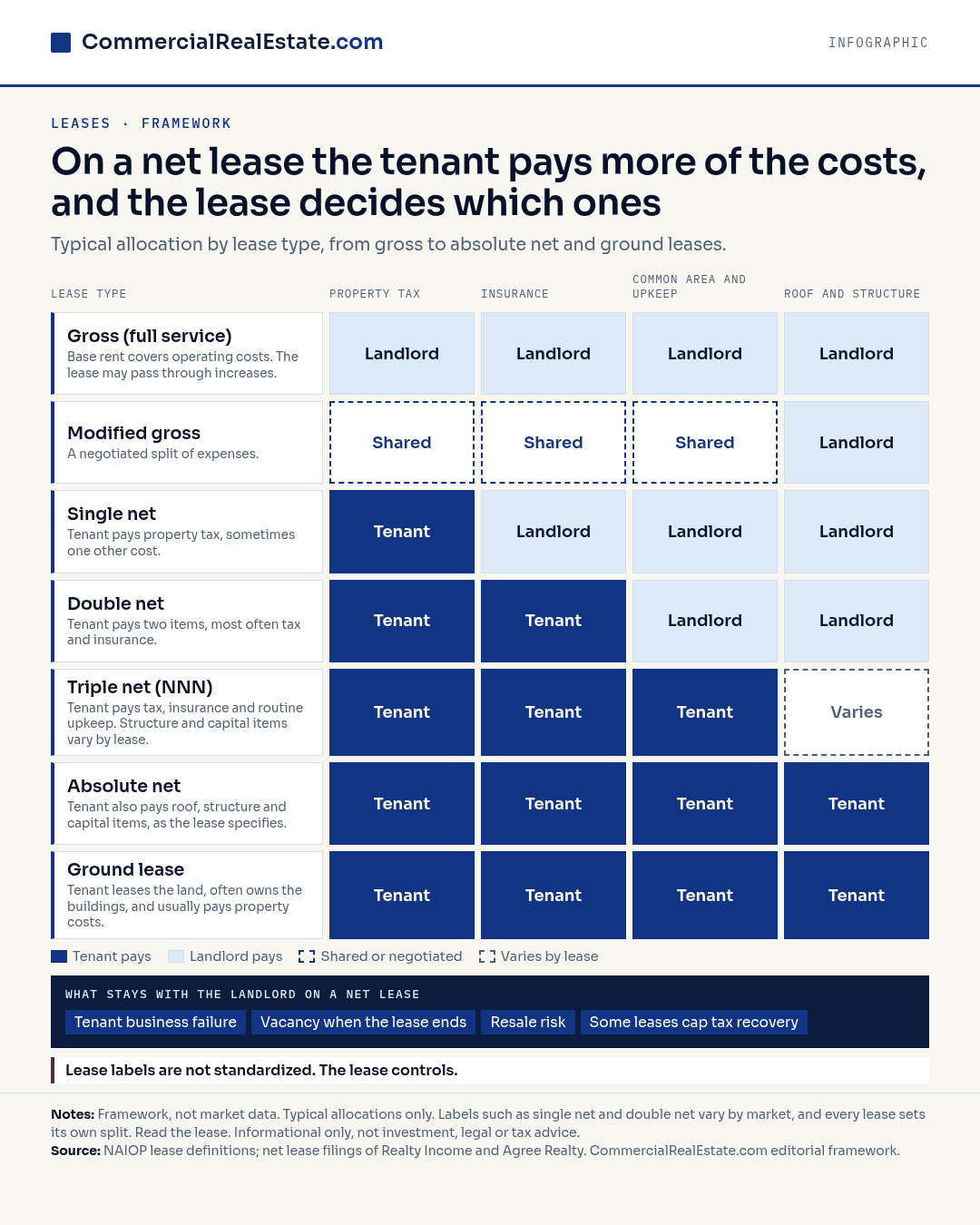
Data table
| Lease type | Property tax | Insurance | Common area and upkeep | Roof and structure | Note |
|---|---|---|---|---|---|
| Gross (full service) | Landlord | Landlord | Landlord | Landlord | Base rent covers operating costs. The lease may pass through increases. |
| Modified gross | Shared | Shared | Shared | Landlord | A negotiated split of expenses. |
| Single net | Tenant | Landlord | Landlord | Landlord | Tenant pays property tax, sometimes one other cost. |
| Double net | Tenant | Tenant | Landlord | Landlord | Tenant pays two items, most often tax and insurance. |
| Triple net (NNN) | Tenant | Tenant | Tenant | Varies | Tenant pays tax, insurance & routine upkeep. Structure and capital items vary by lease. |
| Absolute net | Tenant | Tenant | Tenant | Tenant | Tenant also pays roof, structure & capital items, as the lease specifies. |
| Ground lease | Tenant | Tenant | Tenant | Tenant | Tenant leases the land, often owns the buildings, and usually pays property costs. |
Text version of the graphic
On a net lease the tenant pays more of the costs, and the lease decides which ones.
Typical allocation by lease type, from gross to absolute net and ground leases.
Columns: Property tax, Insurance, Common area and upkeep, Roof & structure. Key: Tenant pays, Landlord pays, Shared or negotiated, Varies by lease.
Gross (full service): Property tax Landlord, Insurance Landlord, Common area and upkeep Landlord, Roof & structure Landlord. Base rent covers operating costs. The lease may pass through increases.
Modified gross: Property tax Shared, Insurance Shared, Common area and upkeep Shared, Roof & structure Landlord. A negotiated split of expenses.
Single net: Property tax Tenant, Insurance Landlord, Common area and upkeep Landlord, Roof & structure Landlord. Tenant pays property tax, sometimes one other cost.
Double net: Property tax Tenant, Insurance Tenant, Common area and upkeep Landlord, Roof & structure Landlord. Tenant pays two items, most often tax and insurance.
Triple net (NNN): Property tax Tenant, Insurance Tenant, Common area and upkeep Tenant, Roof & structure Varies. Tenant pays tax, insurance & routine upkeep. Structure and capital items vary by lease.
Absolute net: Property tax Tenant, Insurance Tenant, Common area and upkeep Tenant, Roof & structure Tenant. Tenant also pays roof, structure & capital items, as the lease specifies.
Ground lease: Property tax Tenant, Insurance Tenant, Common area and upkeep Tenant, Roof & structure Tenant. Tenant leases the land, often owns the buildings, and usually pays property costs.
What stays with the landlord on a net lease: Tenant business failure, Vacancy when the lease ends, Resale risk, Some leases cap tax recovery.
Lease labels are not standardized. The lease controls.
Lease type, Property tax, Insurance, Common area and upkeep, Roof & structure.
Tenant pays. Landlord pays. Shared or negotiated. Varies by lease.
Notes: Framework, not market data. Typical allocations only. Labels such as single net and double net vary by market, and every lease sets its own split. Read the lease.
How to read this graphic
Use the graphic to decide how much cost risk sits with the tenant before you underwrite a property. On a gross lease the landlord pays every cost, and base rent covers operating costs. A triple net lease, or NNN, shifts tax and insurance to the tenant along with upkeep, while roof and structure varies by lease. Absolute net and ground leases place the roof and structure on the tenant, which changes what the landlord must reserve for capital items and how a lender reads the cash flow. The lease decides.
Read across a row to see where the tenant stops paying. Read down a column to see who carries a single cost. Roof and structure moves last, so check it first, then match each cell to the signed lease. Ask the sponsor which version of each cell the lease contains.
What the graphic does not show
The graphic shows typical allocations only. It is a framework that carries no market data, and labels such as single net and double net vary by market. A cell marked Varies by lease hides real exposure, particularly on roof and structure. The landlord keeps tenant business failure and resale risk, while some leases cap tax recovery. Read the lease.