
Refinancing pressure transmission
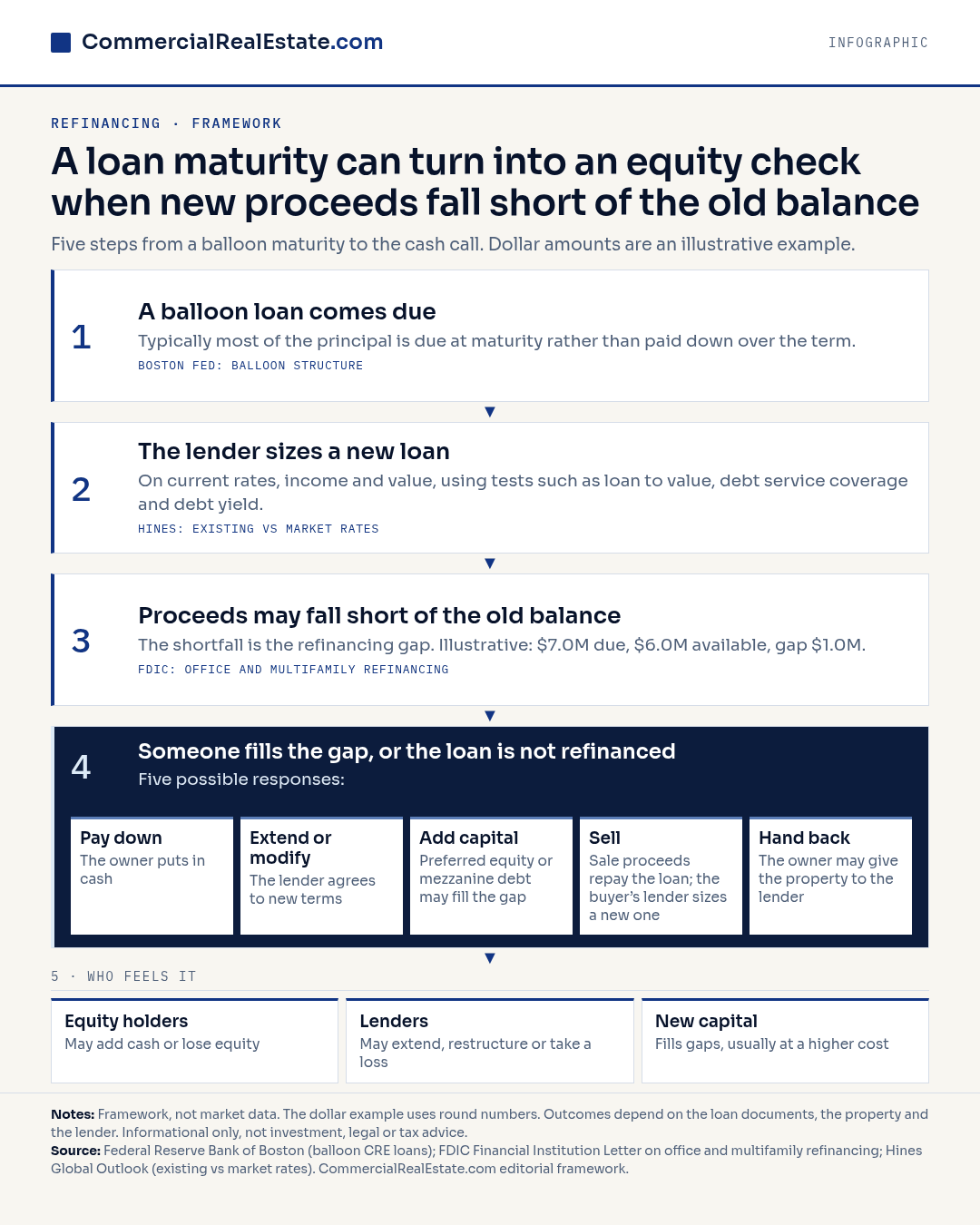
A balloon loan matures, the lender sizes a new loan on today’s terms, and any shortfall becomes a refinancing gap that someone must fill. Illustrative example: $7.0M due, $6.0M available, gap $1.0M.
Data table
| Step | What happens | Source for the point |
|---|---|---|
| 1. A balloon loan comes due | Typically most of the principal is due at maturity rather than paid down over the term. | Boston Fed: balloon structure |
| 2. The lender sizes a new loan | On current rates, income & value, using tests such as loan to value, debt service coverage and debt yield. | Hines: existing vs market rates |
| 3. Proceeds may fall short of the old balance | The shortfall is the refinancing gap. Illustrative: $7.0M due, $6.0M available, gap $1.0M. | FDIC: office and multifamily refinancing |
| 4. Someone fills the gap | Pay down: The owner puts in cash; Extend or modify: The lender agrees to new terms; Add capital: Preferred equity or mezzanine debt may fill the gap; Sell: Sale proceeds repay the loan; the buyer’s lender sizes a new one; Hand back: The owner may give the property to the lender | |
| 5. Who feels it | Equity holders: May add cash or lose equity; Lenders: May extend, restructure or take a loss; New capital: Fills gaps, usually at a higher cost |
Text version of the graphic
A loan maturity can turn into an equity check when new proceeds fall short of the old balance.
Five steps from a balloon maturity to the cash call. Dollar amounts are an illustrative example.
1. A balloon loan comes due. Typically most of the principal is due at maturity rather than paid down over the term.
2. The lender sizes a new loan. On current rates, income & value, using tests such as loan to value, debt service coverage and debt yield.
3. Proceeds may fall short of the old balance. The shortfall is the refinancing gap. Illustrative: $7.0M due, $6.0M available, gap $1.0M.
4. Someone fills the gap, or the loan is not refinanced. Five possible responses: Pay down. The owner puts in cash. Extend or modify. The lender agrees to new terms. Add capital. Preferred equity or mezzanine debt may fill the gap. Sell. Sale proceeds repay the loan; the buyer’s lender sizes a new one. Hand back. The owner may give the property to the lender.
5. Who feels it. Equity holders. May add cash or lose equity. Lenders. May extend, restructure or take a loss. New capital. Fills gaps, usually at a higher cost.
Notes: Framework, not market data. The dollar example uses round numbers. Outcomes depend on the loan documents, the property and the lender.
How to read this graphic
Read the graphic in order, as five steps from maturity to cash call. A balloon loan leaves most of the principal due at maturity. The lender then sizes a new loan on current terms, using tests such as loan to value and debt service coverage. The third step compares the new amount with the old balance. In the example, $7.0M is due and $6.0M is available, so the gap is $1.0M. That gap is the number a sponsor or capital raiser has to plan around.
The fourth step is where the decision sits. Five responses are shown: the owner pays down with cash, the lender extends or modifies, preferred equity or mezzanine debt adds capital, the property is sold, or the owner hands it back. The last step maps who feels each outcome. Equity holders may add cash or lose equity. Lenders may extend or take a loss. New capital fills gaps, usually at a higher cost.
What the graphic does not show
The dollar figures are round numbers built to show the mechanics, so they say nothing about any actual loan or market. The graphic does not show how large a gap is likely to be, how often gaps occur or what a lender will accept. Outcomes depend on the loan documents and the lender. A reader could assume all five responses are open to every owner, yet any of them may be closed off in a given case.